 Paul Brazil

What is the NCVIA?
 Paul Brazil : Nov 10, 2025, 10:46:55 AM
The National Childhood Vaccine Injury Act is the law that protects vaccine access, funds injury compensation, and sustains the nation’s vaccination...
You have a limited time to file a vaccine injury claim. Missing the deadline means you cannot recover compensation, no matter how strong your case is.
The VICP has awarded over $4.8 billion to claimants since inception. So make sure you get your claim in before the deadline is missed. The statute of limitations for filing a vaccine injury claim under the National Vaccine Injury Compensation Program (VICP) is strictly enforced. You have:
These deadlines apply to injuries caused by covered vaccines, including flu, MMR, Tdap, and others listed on the vaccine injury table published by the HRSA. The time limits are set by federal statute and enforced by the United States Court of Federal Claims. The deadlines do not change based on diagnosis, the severity of the condition, or when you became aware the injury was related to vaccine administration.
There is no grace period, extensions, or exceptions. Once the limitations period ends, your right to file and to recover financial compensation, is gone.
If you’ve suffered a vaccine-related injury, the clock starts ticking from the moment the first symptom appears, even if no one connected it to the vaccine at the time. That moment sets your deadline, not a diagnosis, second opinion, or the day you started treatment.
You’re within the filing window if:
You’re out of time if:
Most people don’t realize they qualify until it’s almost too late. If there’s any uncertainty about dates or symptoms, it’s critical to get a timeline review immediately.
Get a free consultation with a specialized vaccine injury attorney now.
To determine if you’re eligible to file a claim under the Vaccine Injury Compensation Program, our attorneys will ask for specific documentation. These details are used to verify timing, medical qualification, and whether your case fits the VICP process.
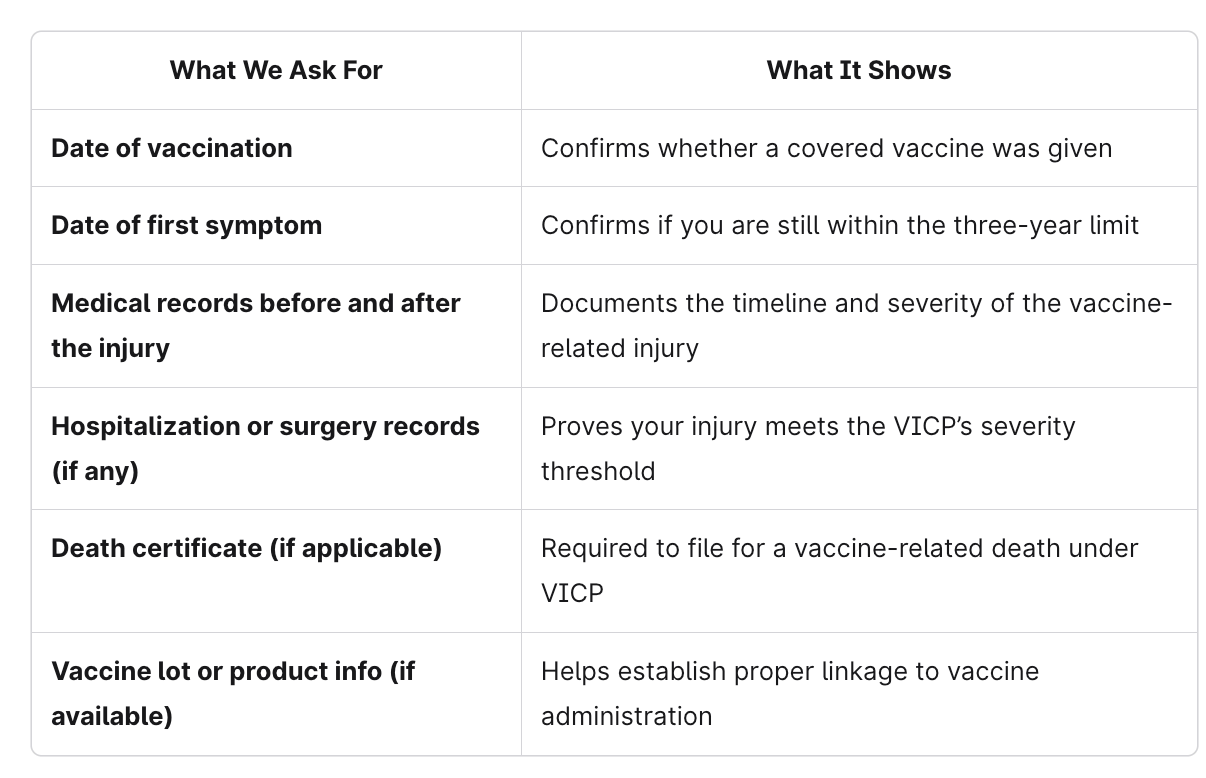
If you don’t have everything, that’s fine. Our attorneys will review what you do have and guide you through the rest. The review is free.
Not every post-vaccine health issue qualifies. The VICP recognizes specific conditions based on medical evidence, timing, and severity. Some are listed directly in the Vaccine Injury Table. Others require more documentation to prove, but both types fall under the same statute of limitations.
There is no separate filing deadline for off-table claims. Whether your injury is listed or not, you still have three years from the first symptom.
These are conditions with presumed causation if they meet timing requirements:
These aren’t listed in the table but can still be compensated if proven medically:
Even if your injury is not on the table, you may still qualify, but the burden of proof is higher. Documentation, medical opinion, and precise timelines become critical.
To file a valid claim, the injury must meet one of the following:
These thresholds are enforced by Health and Human Services, and used to determine basic eligibility before any compensation is considered.
The VICP only allows certain people to file a claim. It depends on who was injured, whether the person is still living, and what their legal or medical status is.
If you received a covered vaccine and experienced a qualifying injury, you can file directly as the petitioner. You must still meet the deadline and severity rules.
Parents or legal guardians can file on behalf of a child. The statute of limitations is not extended for minors. The three-year deadline still begins at the first symptom, even in infancy.
You may file a wrongful death claim if you are the executor, administrator, or legal representative of the deceased’s estate. The two-year death deadline and four-year symptom rule apply.
If the injured person is incapacitated, a legal guardian or authorized representative must file the petition. Supporting documents proving legal authority will be required during review.
You cannot file on behalf of someone without legal standing or without the required documentation. If you're unsure whether you’re eligible to file, our attorneys will review your situation and confirm.
Need a step-by-step breakdown of the VICP claims process?
The VICP claims process is federal, complex, and unforgiving on deadlines. You’re not filing with your local court, you’re submitting a formal petition to the United States Court of Federal Claims, where specialized rules apply, and your case is reviewed by Special Masters, not judges.
Our team at My Vaccine Lawyer has handled thousands of vaccine injury cases, including difficult off-table claims, shoulder injuries, and vaccine-related death petitions. We know how to document first symptoms, build timelines from medical records, and argue eligibility when symptoms aren't neatly recorded.
If you’re uncertain about timing, eligibility, or symptoms, our attorneys will review your information and tell you exactly where you stand. You’ll know if you have a claim, before you commit to anything.
The Vaccine Injury Compensation Act allows up to $250,000 for pain and suffering and death benefits, plus full coverage for medical expenses, lost income, and future care. These are not capped if documented.
SIRVA occurs when a vaccine is injected too high or deep into the shoulder, damaging tissue and reducing motion. If pain starts within 48 hours and lasts over six months, it qualifies as a table injury under VICP. Average compensation for SIRVA claims ranges from $75,000 to $120,000, depending on severity.
Most cases are resolved within 12–24 months. Straightforward table claims can settle faster. Off-table claims or those requiring medical expert testimony may take longer. VICP is a no-fault system, but it’s handled in the United States Court of Federal Claims, not a local court.
A VICP claim is filed in federal vaccine court against the U.S. Department of Health and Human Services, not the vaccine manufacturer. If you're ineligible or outside the deadline, your only option may be a traditional lawsuit, but these are rare, harder to win, and often dismissed due to legal protections for vaccine companies.
You can still file an off-table claim, but you’ll need strong medical evidence proving the vaccine caused your condition. These cases are more complex and make up roughly 25% of VICP payouts. Our experienced vaccine injury lawyershandle both table and off-table claims nationwide.
There are no upfront legal fees. If your claim is successful, our fees are paid directly by the VICP and do not reduce your award. If the claim is denied, we still do not charge you. We represent thousands of vaccine injury clients, including difficult, high-value cases.
Among all adverse reactions covered by VICP, the most common are:
Paul Brazil is a native of Dunmore, Pennsylvania and a graduate of Dunmore High School. For his undergraduate education, he attended Bloomsburg University where he majored in political science. He then went on to earn his JD from Widener University School of Law. Following graduation from law school, Mr. Brazil worked at a large Philadelphia civil defense firm where he litigated workers’ compensation claims and Heart and Lung Act cases. In 2012, he joined with his coworker Max Muller to form Muller Brazil.

.png)
Paul Brazil : Nov 10, 2025, 10:46:55 AM
The National Childhood Vaccine Injury Act is the law that protects vaccine access, funds injury compensation, and sustains the nation’s vaccination...
.png)
Paul Brazil : Aug 12, 2026, 2:18:36 PM
A VICP claim takes about two to three years, on average, from filing to adjudication. That is the current benchmark published by the Health Resources...
Paul Brazil : Feb 4, 2025, 11:15:00 AM
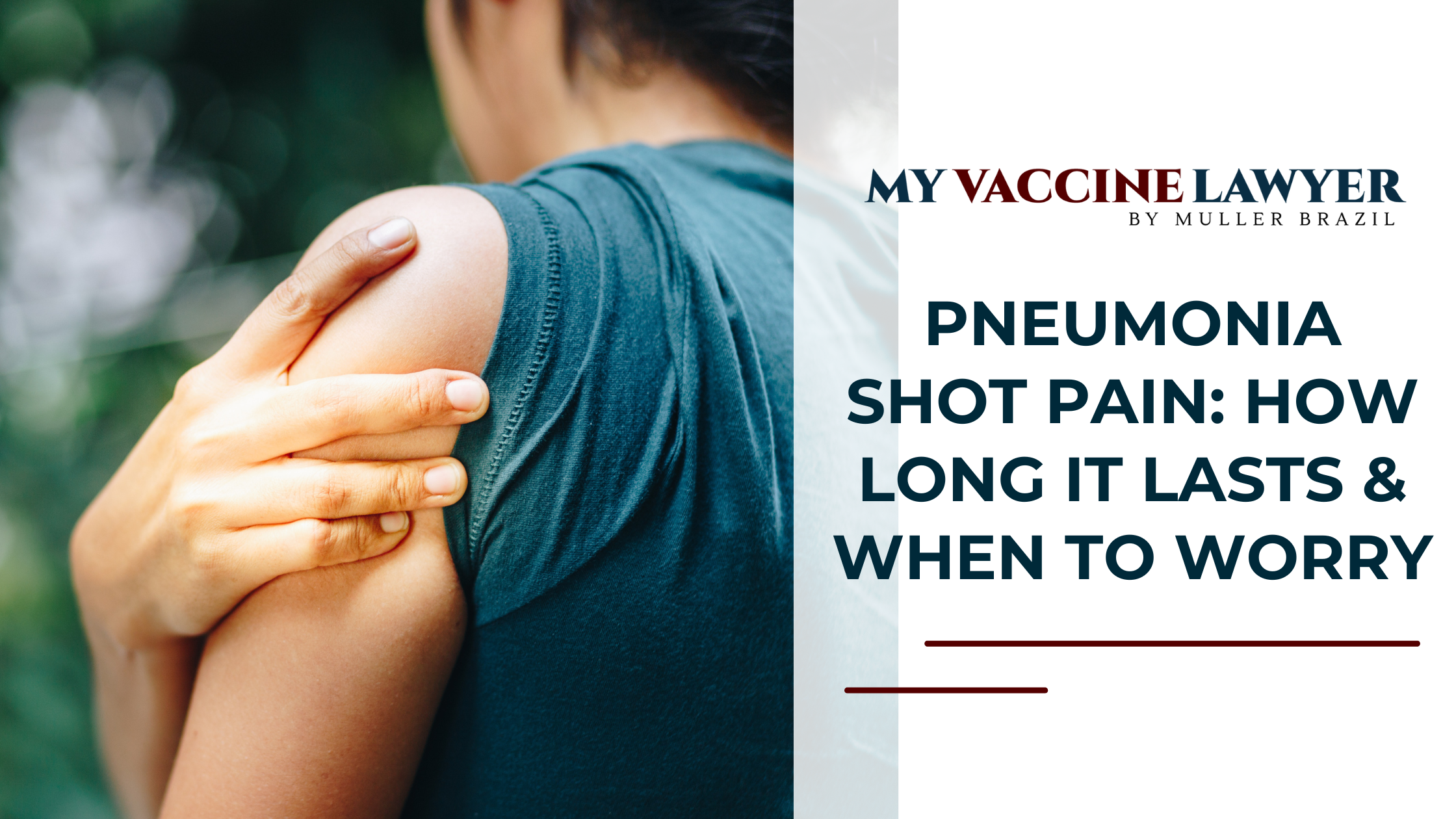
Getting a vaccine is a routine part of staying healthy, but that doesn’t mean it’s always comfortable. If you've recently received a pneumonia shot,...