 Max Muller

How to File a VICP Claim
 Max Muller : Nov 3, 2025, 8:16:50 AM
Most people don’t realize that to file a claim under the national vaccine injury compensation program, you don’t go to your local civil court.
.png)
Filing a vaccine injury claim is not simple, especially when you learn that more than half of all petitions submitted to the National Vaccine Injury Compensation Program (VICP) are ultimately denied.
The specific reasons behind these denials help explain why a specialized and experienced vaccine injury attorney is necessary.
If you’re unsure whether your claim meets the program’s standards, speak directly with a vaccine injury lawyer for a free case review.
Congress established the vaccine injury compensation program under federal law to handle vaccine injury claims outside of traditional litigation. It operates as a no fault system, which means individuals injured by a covered vaccine can pursue compensation without suing healthcare providers or vaccine manufacturers.
Claims are filed in the United States Court of Federal Claims, often referred to as vaccine court. Each case is reviewed by a special master, who evaluates medical evidence, the vaccine injury table, and the strength of the claimed causal relationship between the vaccine and the physical injury.
The program is funded through a $0.75 excise tax on every dose of a covered vaccine. That funding supports the vaccine trust fund, which has issued billions in compensation awards since the program became operational in 1988. These awards cover medical care, lost income, and, in qualifying cases, a death benefit.
A claim moves forward when the evidence shows that a vaccine caused the injury under the legal standard applied in federal court. That standard relies on documented timelines, consistent medical records, and credible scientific evidence. When those elements align, claims succeed. When they do not, the case joins the pool of unsuccessful claimsthat define many VICP denials.
Timeliness is one of the most unforgiving reasons VICP claims get denied, and unlike other deficiencies, missed deadlines cannot be corrected after the fact.
The standard statute of limitations works as follows:
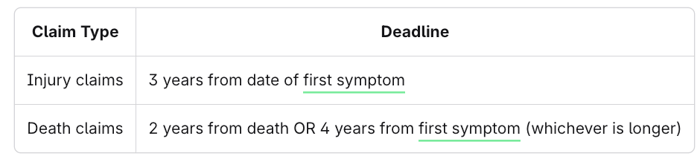
For example, if symptoms first appeared on January 1, 2024, the filing deadline is generally January 1, 2027—regardless of when the condition was formally diagnosed or when you realized a connection to the vaccine administered.
Claims can also be denied for jurisdiction problems:
Late discovery of a condition rarely extends these deadlines. A subtle neurological injury recognized years after the fact will be time-barred if more than three years have passed since the initial symptom date, even if diagnosis came much later.
Before filing, have your timeline reviewed by a vaccine injury lawyer to confirm your claim is still within the legal window.
The VICP only applies to specific vaccines covered under federal law. A claim moves forward when the vaccine administered appears on the vaccine injury table and the injury matches recognized patterns of vaccine related injuries.
The table defines both the covered vaccine and the timing in which symptoms must appear. When those conditions are met, the legal process accepts a causal connection without requiring extensive proof.
Common examples include:
These claims follow a structured path because the connection between the vaccine caused injury and the condition is already recognized.
A different path applies when the injury falls outside those definitions. Claims shift into what the injury compensation program VICP treats as off-table cases, where the burden turns to full proof of a causal relationship. The scientific evidence must show how and when the injury developed, supported by consistent medical records and expert interpretation.
The Department of Health and Human Services updates the table as new data emerges from disease control research and evolving public health guidance. Changes have expanded coverage over time, including the addition of shoulder injury related claims tied to injection technique. The version of the table in effect at the time of the vaccine administered determines how the claim is evaluated.
A vaccine injury claim succeeds when the evidence shows that a vaccine caused the injury under the standard applied in vaccine court. That standard is “preponderance of the evidence,” which means the claimed causal relationship is more likely than not based on the full record.
This is where many VICP claims fail, and where experienced legal representation becomes critical. For injuries that do not fall directly within the vaccine injury table, the special master applies a structured legal test. Each element must be supported with credible scientific evidence, consistent medical records, and a clear sequence tied to the vaccine administered.
The court looks for three things:
Each element carries weight. When one is missing or unsupported, the claim weakens and often results in denial. This is also where unrepresented claimants run into problems. Medical records may be incomplete. Timelines may be unclear. The connection between the vaccine caused injury and the condition may not be presented in a way that satisfies the court’s standard.
A typical denial follows a consistent pattern within this framework. A claimant connects a vaccine to a condition diagnosed later, but the medical records show gaps between the first symptom and diagnosis.
The proposed claim lacks supporting scientific evidence, and the timing does not align with known responses to the vaccine administered. When the special master evaluates the claim, the causal connection does not meet the required standard, resulting in one of many unsuccessful claims within the national vaccine injury compensation system.
An experienced attorney addresses these issues before the claim is filed. That includes organizing medical evidence, working with qualified experts, and presenting the case in a way that meets the legal requirements applied in federal court.
If your case involves complex medical issues, our attorneys will evaluate your claim to see if it meets the legal standard before it’s filed.
The VICP standards adjusts to significant vaccine related injuries, not every transient side effect. Many denials arise because the claimed injury doesn’t meet statutory severity thresholds.
Compensable injuries generally must meet at least one of these criteria:
Short-lived reactions like brief fever, injection site soreness, temporary fatigue, rarely qualify for compensation. Claims are also denied when medical records show prompt, full recovery within weeks, or when ongoing symptoms are only self-reported without objective clinical findings.
Evidence that strengthens severity claims:
Evidence that often leads to denial:
Some conditions, alleged learning disabilities or behavioral changes, for example, are particularly difficult to tie to a specific vaccination event without extensive neuropsychological testing and records showing a clear change point coinciding with when the vaccine was administered.
The VICP has specialized procedural rules, and technical missteps are a frequent, but preventable, basis for dismissals.
Common filing defects include:
Self-represented petitioners (“pro se”) often struggle with evidentiary rules requiring formal expert reports, procedural deadlines, and response requirements. This frequently results in dismissal for failure to prosecute or failure to meet the burden of proof.
Here’s what many petitioners don’t realize: the program typically pays reasonable attorneys fees and legal fees directly from the Trust Fund for claims filed in good faith with a reasonable basis, regardless of whether compensation is ultimately awarded. This means hiring experienced legal representation carries little financial risk to you.
Claims may also be denied when petitioners:
These procedural failures lead to dismissals even when the underlying vaccine injury claim might otherwise have merit.
Health and human services and the Department of Justice routinely review claims for alternative causes. Identifying a more likely non-vaccine explanation often results in denial.
Alternative explanations frequently raised by government attorneys include:
Even when petitioners present a plausible vaccine theory, the special master must deny compensation if evidence shows another cause is more probable. Epidemiological data, such as large population studies, showing no increased risk of certain conditions after specific vaccines, are regularly cited to find that the causal relationship is not established.
Despite scientific consensus rejecting links between vaccines and certain conditions, some petitioners continue to file such claims. These are almost always denied. For example, claims involving generalized fatigue after a vaccination are often denied when the medical records do not establish a clear and consistent link between the vaccine and the condition.
Take Control of Your Injury Today
After a special master issues an unfavorable entitlement decision, the ruling includes written reasoning, whether causation wasn’t proven, the statute of limitations expired, or the vaccine wasn’t covered, and a judgment is entered in the Court of Federal Claims.
The appeals process includes several potential steps:
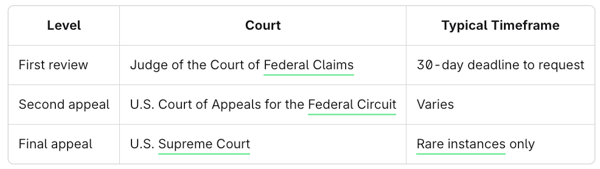
Appeals focus on legal or procedural error, not simply disagreement with the special master’s decision on facts.
Once VICP remedies are exhausted or rejected, petitioners may pursue civil lawsuits against vaccine makers or healthcare provider administrators. However, federal law creates significant obstacles. The Supreme Court’s 2011 decision in Bruesewitz v. Wyeth established that the vaccine act shields manufacturers from design-defect claims, substantially limiting remaining civil suit options.
Most VICP denials follow patterns we see immediately. A vaccine injury claim does not succeed because an injury occurred. It succeeds because the claim fits the legal and medical standards applied in vaccine court so we evaluate that from the start.
We begin by determining whether the claim will meet the requirements of the VICP. That includes:
At this stage, we can identify the same issues that lead to successful claims.
Most claims filed without structure fail for reasons that are visible early. In many cases, the injury is real and documented, but the claim is not structured to meet the court’s standard. The issue is how the case is presented to the court of federal claims. We look for:
These are the points where the special master will focus. If they are not addressed before filing, the outcome is predictable.
Our role is to resolve those issues before the claim is evaluated. My Vaccine Lawyer works with medical professionals to support the claim with credible scientific evidence and expert testimony. We organize the record so the progression of the injury is clear and consistent and present the case in a way that aligns with how decisions are made under federal law.
That preparation changes how the claim is received by health and human services and reviewed in the United States court.
The difference between approved federal claims and denied ones is not random. It comes down to whether the claim meets the standard before it is filed. We identify that early and build the case around it. We then move forward when the claim has potential grounds for compensation within the VICP.
Start with a free consultation and find out where your claim stands before moving forward.
Not necessarily. A denial typically means the petitioner did not meet the legal burden of proof, showing that causation was “more likely than not.” Special masters rely on available evidence and standards like the Althen test.
In some cases, the decision acknowledges uncertainty while still finding insufficient evidence to award compensation. The ruling addresses whether you proved your case, not whether the vaccine was definitively ruled out as a cause.
For covered vaccines, you must first exhaust VICP remedies. After a final judgment, you may reject it and pursue civil litigation in state or federal court. However, you’ll face different legal standards and significant liability protections under the vaccine act. The Supreme Court’s Bruesewitz decision bars design-defect claims against vaccine manufacturers, substantially limiting civil litigation options.
Generally, no. Once a final judgment is entered, refiling is not permitted unless exceptionally narrow grounds apply, such as certain types of fraud or clerical error. Your options are typically limited to the appeals process through the federal circuit or accepting the decision.
During the COVID-19 public health emergency declared under the prep act, most COVID-19 vaccine claims were routed to the Countermeasures Injury Compensation Program (CICP), not the VICP.
Unlike most civil cases, the VICP typically pays attorneys fees and costs directly from the Vaccine Injury Compensation Trust Fund for petitions filed in good faith with a reasonable basis.
Mr. Muller currently devotes the majority of his law practice to aggressively fighting for the victims of unsafe drug and medical device injuries, as well as vaccine injuries and vaccine reactions involving the flu shot, TDaP/DTaP vaccine, and more. He has handled hundreds of SIRVA injury cases (shoulder injury related to vaccine administration), especially those involving bursitis, tendonitis, frozen shoulder, and rotator cuff tears. Mr. Muller also handles cases where vaccines caused serious nerve injuries such as Guillain-Barre Syndrome. Mr. Muller has recovered millions of dollars in compensation for his clients in the Vaccine Injury Compensation Program.

Max Muller : Nov 3, 2025, 8:16:50 AM
Most people don’t realize that to file a claim under the national vaccine injury compensation program, you don’t go to your local civil court.
Max Muller : Aug 21, 2026, 11:26:04 AM
No. For most claims under the National Vaccine Injury Compensation Program (VICP), you do not need a lawyer with an office near your home. You need...
.png)
Max Muller : Mar 30, 2026, 9:28:36 AM
Legal rights and compensation for Chronic Inflammatory Demyelinating Polyneuropathy (CIDP)/